What Happens When a Sauna Business Gets More Members Than It Can Handle?

Growth should feel good, but for a busy sauna business, success can eventually create a new problem. More calls and memberships can mean frustrated regulars who cannot book their preferred times.
If demand is outgrowing your space, you are not failing. You are reaching a capacity limit.
This guide covers the key questions owners should ask:
- ●Are you over capacity?
- ●Should you stop selling memberships?
- ●Is it time to raise prices?
- ●Should you open a second location?
Whether you run one infrared room or a multi-room facility, the goal is the same: protect the member experience while creating room for sustainable growth.
For a deeper breakdown, check out everything you need to know about starting a Health and Wellness Business.
When More Members Become a Capacity Problem
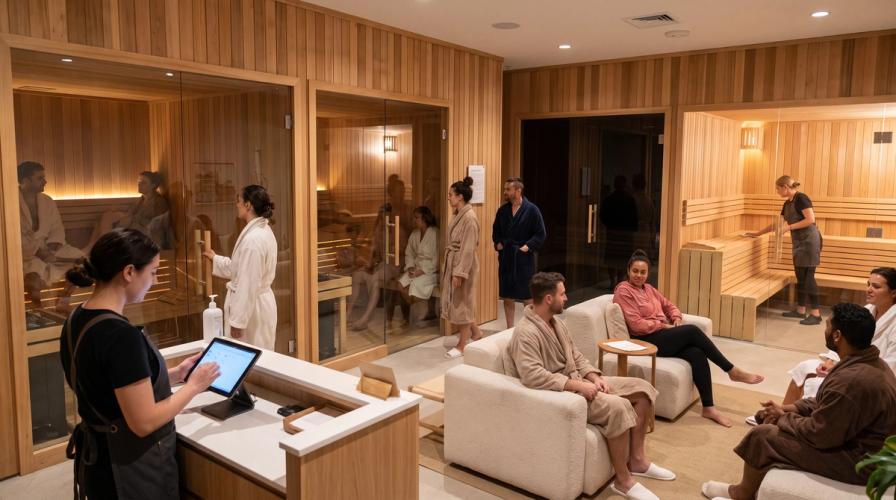
A sauna business has a fixed capacity based on:
- ●Number of rooms
- ●Operating hours
- ●Staff availability
- ●Equipment limits
- ●Cleaning and reset time
When memberships grow faster than these resources, capacity becomes a problem. For example, three rooms with one-hour sessions can only serve a limited number of customers each day, regardless of membership growth.
The bigger challenge is peak-hour demand. Early mornings, evenings, and weekends are usually busiest, while midday may have plenty of availability. This means you can have empty rooms during the day but still struggle to accommodate customers at 6 p.m.
Staff and equipment also affect capacity. Cleaning, maintenance, customer service, and booking management all require time. If any part of the system is pushed too far, the customer experience can suffer.
So, measuring sauna capacity means looking beyond membership numbers and considering rooms, schedules, staff, equipment, and peak-hour demand together.
Read More | Wellness Service Business in Miami: From Idea to First Client in 30 Days.
Warning Signs Your Sauna Business Is Over Capacity
Overcapacity rarely announces itself. It creeps in through small frustrations that are easy to dismiss until they stack up. The clearest early signal is booking friction: members complaining that the times they want are always gone. Close behind are longer waits at the door, rushed cleaning between sessions, and staff who seem stretched thin even on ordinary days.
The table below lays out the signs that matter most, what usually causes each one, and why it hurts your business if you ignore it. Read it as a quick self-check rather than a diagnosis.
| Warning sign | Common cause | Impact on the business |
|---|---|---|
| Peak slots book out days ahead | Demand concentrated in evenings and weekends | Members feel locked out and start looking elsewhere |
| Rushed or skipped room resets | Not enough time or staff between sessions | Cleanliness drops, reviews suffer |
| Rising cancellation and no-show rates | Members grab any slot, then bail | Wasted capacity and lost revenue |
| Staff burnout and turnover | Too many sessions per shift | Service quality falls, hiring costs rise |
| More equipment breakdowns | Heaters run near-constant with little downtime | Closures, repair bills, refunds |
If you recognize three or more of these, your sauna business is likely operating past its comfortable limit. The good news is that every one of them has a fix, and most do not require a bigger building.
How Overcapacity Affects Customers
Members do not see your capacity numbers. They experience the impact through:
- ●Harder bookings: Members struggle to find convenient time slots.
- ●Longer waits: Sessions may run late, creating delays.
- ●Rushed cleaning: Rooms may not feel as clean or prepared as expected.
- ●Less relaxation: Crowded schedules can turn a calming experience into a stressful one.
- ●More complaints: Frustration can lead to negative reviews and cancellations.
These problems often affect your most loyal members first. Protecting their experience is essential for maintaining renewals and long-term customer loyalty.
Should You Stop Selling Memberships?
When capacity gets tight, stopping membership sales may seem like the easiest solution. But instead of stopping growth completely, focus on controlling when and how new members join.
Consider these options:
- ●Set a membership cap: Limit active memberships based on your rooms, hours, and ability to deliver a good experience.
- ●Create a waitlist: Keep interested customers engaged and use the list when new capacity becomes available.
- ●Improve reservations: Use a reliable booking system, fair slot allocation, and no-show policies to protect available time.
- ●Offer off-peak memberships: Create lower-priced plans for midday or early-afternoon sessions to fill quieter hours.
- ●Monitor capacity regularly: Adjust membership limits as your schedule, staffing, and equipment change.
Stopping membership sales completely should be a last resort. Smart capacity management lets you keep growing without overcrowding your busiest hours.
Ways to Handle Excess Demand
There is no single right answer to too much demand. The best response depends on whether your problem is total volume, peak-hour concentration, or thin margins. Most owners end up combining two or three of the levers below. Here is how the main options compare so you can pick the ones that fit your situation.
| Approach | Best when | Trade-off |
|---|---|---|
| Membership cap | Rooms are consistently full across the week | Slows new revenue growth |
| Waitlist | Demand is strong but you want controlled onboarding | Requires follow-up to avoid drop-off |
| Extended hours | Off-peak times still have room | Higher staffing and energy costs |
| Off-peak plans | Midday sits empty, evenings overflow | Lower price per member |
| Pricing changes | Peak slots are always oversubscribed | Risk of member pushback if unexplained |
| Adding capacity | Demand is proven and durable | Upfront cost and build time |
Notice that most of these cost little to try. Adjusting sauna pricing or launching an off-peak plan can smooth demand within a single billing cycle, while adding physical capacity is the slow, expensive last step. Start with the cheap levers and measure before you spend.
Want to start a Health and Wellness Business? Plan it with a proven and trending wellness business model.
How to Increase Capacity Without Opening Another Location
Before signing a second lease, look for ways to increase capacity within your existing space.
- ●Improve scheduling: Shorten session gaps, stagger start times, and add clear buffers between bookings to create more usable slots.
- ●Add peak-hour staff: Extra help during busy periods can speed up check-ins, room resets, and customer service.
- ●Extend operating hours: Early mornings and later evenings can create additional capacity, especially with small incentives for off-peak bookings.
- ●Improve workflows: Prepare towels in advance, automate booking confirmations, and identify delays in the room-reset process.
- ●Track room turnover: Find out exactly how much time each reset takes and look for ways to reduce unnecessary downtime.
Increasing sauna capacity often starts with better operations, not more space. Optimize the resources you already have before investing in a second location.
When Should You Raise Prices or Expand?
Pricing, added capacity, and a new location solve different problems, and confusing them is a costly mistake. Raising prices makes sense when demand consistently outstrips supply, and you are turning people away at peak. A price increase both funds better service and gently rations scarce slots. Adding a room or two fits when demand is durable, but a full second site is too big a leap. Opening another location only makes sense once your first site is reliably full, profitable, and running on systems you could hand to a manager.
The comparison below shows which move matches which situation. Match your reality to the row that fits before you commit capital.
| Situation | Best move | Why |
|---|---|---|
| Peak always sold out, off-peak still open | Raise peak pricing or add off-peak plans | Rations demand without new build cost |
| Consistently full, healthy waitlist, room to build | Add capacity on site | Cheaper and faster than a new location |
| First site full, profitable, systemized | Consider sauna business expansion | Proven model worth replicating |
| Full but margins thin | Fix pricing and costs first | Expanding a weak model multiplies the weakness |
The theme across all of these is proof. Do not expand on a hopeful feeling. Expand on numbers that have held steady for several months.
What Metrics Should a Sauna Business Track?
You cannot manage capacity without measuring it. Focus on these key metrics:
- ●Utilization rate: Track how many available session slots are booked, especially by hour and day.
- ●Active memberships: Monitor total members and weekly membership growth.
- ●Cancellations and no-shows: Measure unused slots that could have been resold.
- ●Revenue per member: Check whether membership growth is actually increasing profitability.
- ●Peak-hour demand: Identify the times when your rooms are under the most pressure.
- ●Equipment downtime: Track how often rooms or heaters are unavailable.
You do not need expensive software to monitor these numbers. A simple weekly review can help you spot capacity problems before they lead to poor reviews, complaints, or cancellations.
Common Mistakes to Avoid
Avoid these common mistakes when managing a growing sauna business:
- ●Overselling memberships: Taking on more members than your rooms and schedule can comfortably handle can damage customer trust.
- ●Ignoring peak demand: Average occupancy can hide serious capacity problems during busy hours.
- ●Understaffing busy periods: Cutting staff during peak times can lead to slower service, poor reviews, and frustrated members.
- ●Skipping maintenance: Delaying heater and equipment servicing can cause breakdowns, closures, and refunds.
- ●Expanding too quickly: Opening a second location before the first one is efficient and profitable can simply multiply existing problems.
The best approach is to fix operational issues first and expand only when the numbers support it.
A Simple Growth Strategy

Follow a clear sequence before investing heavily in expansion:
- Measure demand: Track utilization by hour, cancellations, no-shows, and revenue per member for a few weeks.
- Control demand: Set a membership cap, create a waitlist, improve reservation rules, and offer off-peak memberships.
- Improve operations: Optimize scheduling, add staff during busy periods, and speed up room resets.
- Adjust pricing: Raise or restructure prices when demand consistently supports it.
- Add capacity: Consider another room if the waitlist remains strong.
- Open a second location: Expand only when the first location is consistently profitable, and its systems work well.
The key is to measure first, optimize second, and spend last. A capacity problem is often a sign that your sauna business is ready for its next stage of growth.
Read More | How to Start a Mobile Sauna or Cold Plunge Rental Business in Bozeman, MT: Permits and Costs.
Final Thoughts
A full sauna schedule is not necessarily a problem. It is a sign that customers value what you offer. The key is making sure growth does not come at the cost of the experience that built your membership base.
Start by measuring capacity, managing peak demand, improving daily operations, and using your existing space more efficiently. Only then consider higher prices, additional rooms, or a second location.
Smart growth is not about fitting in as many members as possible. It is about growing without giving your customers a reason to leave.
Ready to Get Started?
Growing a sauna business is achievable with the right planning. Success comes from managing capacity, understanding customer demand, improving operations, and knowing when to invest in additional space or equipment.
BossWorks helps you turn your business idea into a practical plan based on your budget and goals. From estimating costs and identifying growth opportunities to creating a step-by-step roadmap, everything is organized to help you move forward with confidence.
Instead of guessing when to add capacity or expand, you get a clear, structured approach to managing growth, protecting customer experience, and building a stronger business.
Frequently Asked Questions
When peak slots are consistently full, bookings become difficult, and cancellations or service issues start increasing.
Not necessarily. Set a membership cap, use a waitlist, and offer off-peak plans instead.
Raise pricing when demand is consistently high. Consider a second location only after the first is profitable and well-managed.
Improve scheduling, reduce room turnover time, add peak-hour staff, and extend operating hours.
Track utilization, active memberships, bookings, cancellations, no-shows, revenue per member, peak demand, and equipment downtime.