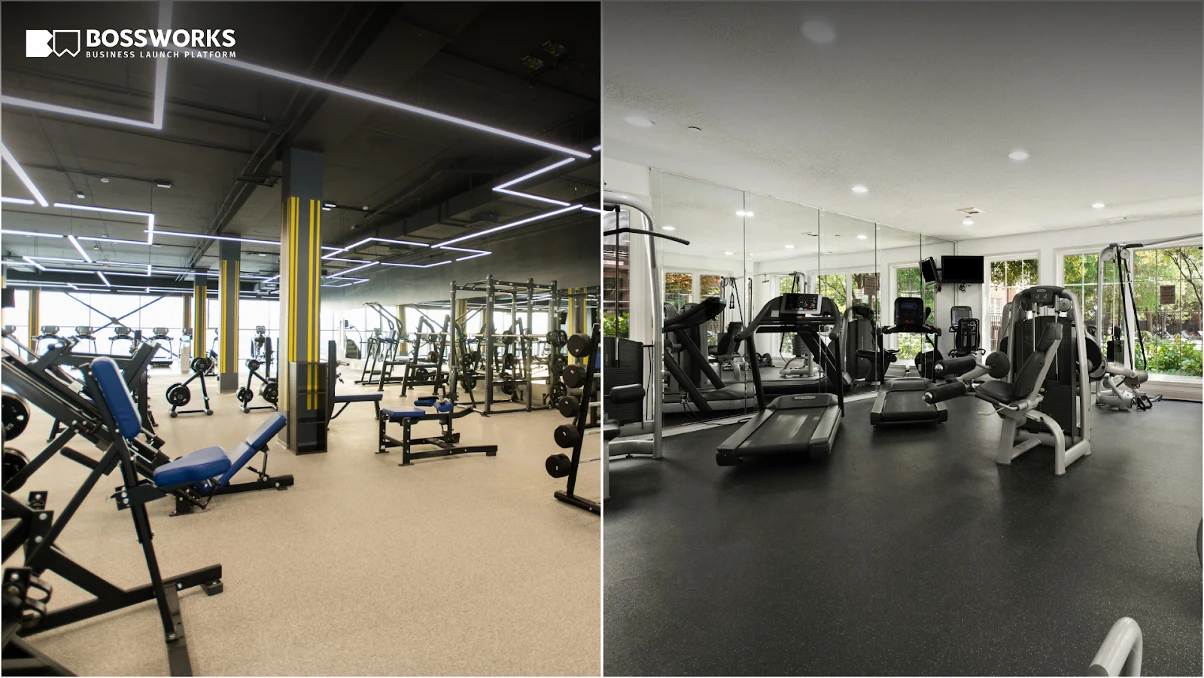
What does it actually cost to start a fitness business?
That depends on whether you're counting the startup costs or the profit you'll actually keep.
A 6,000-square-foot gym can gross twice as much as a 1,500-square-foot studio and still pay its owner less. The owners who win this game aren't the ones who spend the most. They're the ones who understand what they're really paying for. That's exactly what BossWorks helps you figure out before you sign anything.
The cost to open a traditional gym runs 4–6x higher than a boutique fitness studio. That's not a rounding error. That's the difference between draining your savings and draining your savings plus your parents' retirement fund.
Where the Profit Actually Lives
Boutique fitness studio math:
- •200 members × $180/month = $36,000 revenue
- •Operating costs: ~$22,000
- •Monthly profit: ~$14,000
- •Margin: 35–40%
Traditional gym math:
- •800 members × $45/month = $36,000 revenue
- •Operating costs: ~$30,000
- •Monthly profit: ~$6,000
- •Margin: 15–18%
Same revenue. Wildly different take-home.
The boutique owner manages 200 people and keeps $14K. The gym owner juggles 800 members, a dozen employees, and constant equipment issues and keeps $6K.
According to IBISWorld, the gym and fitness industry operates on notoriously tight margins, with most traditional facilities running between 10–20% profitability. Boutique studios consistently outperform on margin percentage, even when total revenue is lower.
Want to know your actual profit potential? BossWorks builds financial projections specific to your concept so you see the real numbers, not averages.
Break-Even Reality
Boutique fitness studio: 12–18 months to consistent profit.
Traditional gym: 18–36 months. Sometimes longer.
When your gym equipment cost alone exceeds most boutiques' entire startup budget, you need a lot more members paying a lot more months before the math works. Understanding your break-even point before signing a lease is the difference between informed risk and expensive guessing.
The Stuff Nobody Mentions
Boutique fitness studio limitations:
- •The capacity ceiling is real. Twenty spots per class, five classes daily, that's your max. Growth means opening another location.
- •Instructor dependency can sink you. Your business lives and dies by who's teaching. One bad hire tanks your reviews overnight.
- •Trend risk exists. Single-modality studios struggle when that workout falls out of favor.
Traditional gym limitations:
- •Margins are brutal. At 12–15% profit, two slow months erase six good ones.
- •Equipment replacement never stops. Commercial gear needs replacing every 5–7 years. That bill keeps coming.
- •Staffing complexity multiplies. Managing 12 employees is a completely different job from running a studio with three instructors.
Worried about hidden risks in your chosen model? BossWorks identifies the pitfalls specific to your concept before they become expensive surprises.
Which Model Fits You?
- •You've got $50K–$150K to invest, not $300K+
- •You're passionate about one specific workout style
- •You want to teach, build community, and know members by name
- •Higher margins matter more than higher gross revenue
- •You want profitability in 12–18 months
- •You're okay with a lower ceiling but a safer floor
- •You have access to $300K+ in capital
- •You want to serve a broad market, not just a niche
- •You're comfortable managing larger teams
- •Your area genuinely lacks quality gym options
- •You can survive 18–36 months before solid profit
- •Higher total revenue matters more than margins
What the Survivors Actually Do
The boutique owners who make it treat their space like a premium product. High prices, intimate classes, communities that stick.
The traditional gym owners who make it a habit to watch their weekly metrics religiously. They know exactly how many members they need, what retention looks like, and where every dollar goes.
The ones who fail? They pick a model based on what sounds impressive instead of what fits their capital, market, and lifestyle.
Jake teaches three classes a day and clears six figures. Marcus works 60-hour workweeks managing staff and fixing treadmills.
Both paths work. Only one ran the math first.
Planning to Launch a Fitness Studio or Gym?
BossWorks helps aspiring fitness entrepreneurs plan and launch with clarity without the guesswork that burns through savings.
We work with future studio and gym owners to:
- •Compare both models side-by-side with real cost breakdowns for your specific market so you choose based on math, not assumptions
- •Map your exact startup costs including build-out, equipment, permits, and working capital for whichever path you choose
- •Build permit timelines specific to your city, including health department requirements, zoning approvals, and inspection schedules
- •Create realistic financial projections covering break-even points, monthly overhead, member targets, and the runway you need to survive year one
- •Identify hidden costs and risks unique to each model from equipment replacement cycles to instructor dependency to margin compression
- •Develop a launch roadmap with milestones and deadlines, so every decision happens in the right sequence
Whether you're leaning boutique, considering traditional, or genuinely unsure which fits your capital and lifestyle, BossWorks serves as your planning partner turning scattered research into a clear decision and actionable plan.
Join the waitlist and get your personalized fitness business plan before you spend your first dollar.
Launch BusinessPlanning to Launch a Fitness Studio or Gym?
Get your personalized fitness business plan before you spend your first dollar.
Frequently Asked Questions
Boutique studios run 25–35% margins. Traditional gyms run 10–20%. Higher margins with boutique, but lower total revenue ceiling.
Traditional gyms run $255,000–$1,060,000+. Boutique fitness studios run $53,000–$167,000. The difference is mainly in the build-out and gym equipment cost.
Boutique fitness studio: 12–18 months. Traditional gym: 18–36 months.
Cardio machines and commercial weights. Full traditional gym setups run $100K–$500K+. Boutique equipment runs $15K–$60K, depending on the concept.
Boutique fitness studio. Lower fitness business startup costs, faster path to profit, and higher margins make it a safer bet for first-time owners without deep pockets.